
President Xi Jinping Chairs the 33rd APEC Economic Leaders’ Meeting and Delivers Important Remarks
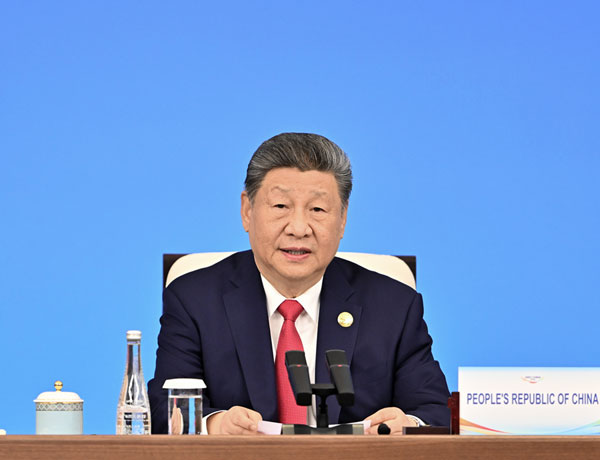
On the morning of November 19, 2026, Chinese President Xi Jinping chaired the 33rd APEC Economic Leaders’ Meeting at the Shenzhen International Communication Center and delivered important remarks titled “Building an Asia-Pacific Community and Writing a New Chapter of the Asia-Pacific Miracle.”
Shenzhen in November enjoys refreshing breezes and is decorated with blooming flowers.
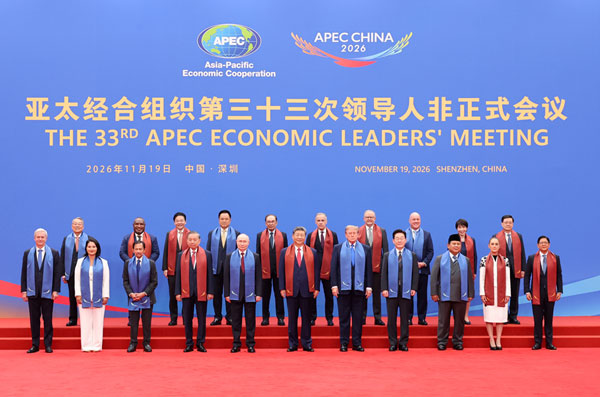
President Xi warmly welcomed the leaders and representatives of the APEC member economies and a head of international organization attended the meeting. He cordially shook hands with them, had a group photo taken and then chaired the meeting.
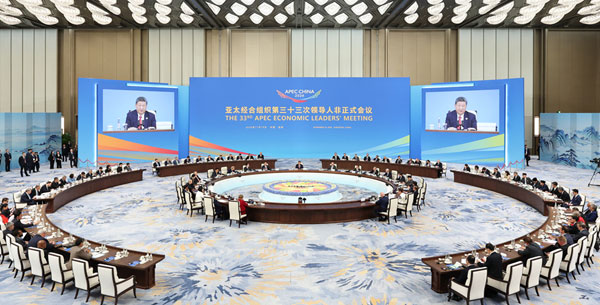
President Xi pointed out that the launch of APEC more than 30 years ago started a remarkable journey toward building an Asia-Pacific community. Over three decades and more, our region has witnessed progress with each passing day, and created the Asia-Pacific miracle of rapid economic growth. In the face of new opportunities and challenges, we must adapt to the new realities, take new strides, and open up new prospects for Asia-Pacific cooperation. Together, we must strive to build an Asia-Pacific community characterized by solidarity and mutual assistance, openness and integration, enterprise and innovation, as well as inclusive development.
First, adhering to solidarity and mutual assistance. We must expand our shared interests, meet the difficulties and challenges together, and steadily build a shared sense of community. Second, adhering to openness and integration. We should steadily advance economic integration and develop a cooperation pattern that is open and integrated, rather than exclusive or fragmented, champion free and open trade and investment, and open up more space for economic growth in the Asia-Pacific. Third, adhering to enterprise and innovation. It is vital to encourage scientific and technological exchanges and cooperation, facilitate the commercialization of innovation outcomes, and foster an open, fair, just and nondiscriminatory environment for cooperation. We need to encourage innovation in institutions and ideas as well as structural reform, and further unleash the economic dynamism and potential of our region. Fourth, adhering to inclusive development. We should make sure development benefits everyone, deliver for the people, accommodate the comfort level of all parties, and foster favorable conditions for turning the vision of an Asia-Pacific community into reality.
President Xi underscored that China is an advocate, promoter and forerunner of Asia-Pacific economic cooperation. We would like to work with all parties to pool wisdom and synergy in building the four key pillars of an Asia-Pacific community.
First, we should strengthen the pillar of economy and trade. The Free Trade Area of the Asia-Pacific (FTAAP) is a shared vision of APEC members. It is important to make steady progress in realizing this vision and setting a higher standard for openness. Efforts should be made to align various regional economic and trade agreements, boost trade and investment facilitation and digitalization, and reduce barriers to trade and investment. It is also important to enhance policy dialogue, and carry out experience sharing and technical cooperation, to help the parties build capacity for participating in high-standard economic and trade arrangements.
Second, we should upgrade the pillar of connectivity. Connectivity is a nexus of regional economic integration. We should strengthen physical connectivity by improving the infrastructure network, deepen institutional connectivity by harmonizing policies and regulations, and enhance people-to-people connectivity by facilitating travel for business, tourism and other purposes, and promoting cultural exchanges for better mutual understanding and closer ties among our peoples.
Third, we should foster the pillar of innovation. The digital economy and artificial intelligence (AI) are the engines of innovation-driven growth. We should strengthen digital infrastructure development, improve data governance and collaboration in the region, and achieve efficient, convenient and secure cross-border data flow. We should build an open ecosystem for innovation, encourage the broad application of AI, and promote the innovation-driven transformation and upgrading of industries.
Fourth, we should enhance the pillar of development. We should strengthen capacity building, promote regional cooperation on energy and food security, and deepen anti-corruption governance across borders. We should coordinate the development of resources, the environment and population,and expand green and low-carbon cooperation to achieve sustainable economic growth. We should support livelihood improvements and invest in the people, launch healthy aging programs, facilitate employment and the development of vocational skills, and support women’s economic empowerment and young talent exchanges to tap into the full potential of talent across the Asia-Pacific.
President Xi announced new measures China would take to support Asia-Pacific cooperation, including providing US$20 million to support APEC’s practical cooperation, establishing a Center for Asia-Pacific Community Studies in Shenzhen to conduct policy research and exchanges and provide intellectual support, and setting up cooperation institutions in such areas as digital technology, cross-border data flow, clean energy, and the development of SMEs, to contribute to innovation-driven and green growth in the Asia-Pacific.
Leaders and representatives of member economies delivered remarks in turn on the theme of the meeting, “Building an Asia-Pacific Community to Prosper Together.” All parties spoke highly of the fruitful outcomes of the APEC China Year, thanked China for its excellent work, and made positive responses to the major initiatives and measures put forward by President Xi. The parties expressed readiness to deepen cooperation across various fields, jointly respond to risks and challenges, further promote the development of APEC, and contribute to peace, stability and prosperity in the region and beyond. Kristalina Georgieva, Managing Director of the International Monetary Fund, was invited to give a briefing on the current global economic situation.
After listening to the remarks of all parties, President Xi made concluding remarks and put forward three proposals for advancing high-quality Asia-Pacific cooperation. First, firming up confidence. We should turn our consensus on building an Asia-Pacific community into actions and our vision into reality. Second, keeping to the right direction. We should remain firmly committed to the overarching goal of building an Asia-Pacific community and advance cooperation in all fields with a strong sense of responsibility, to jointly create an even brighter future for the Asia-Pacific and build a community with a shared future for humanity. Third, taking concrete and steadfast actions. We should focus on development, the largest common denominator of all parties, respect objective laws, take solid and down-to-earth actions and deliver solid results, to continuously achieve tangible and accessible outcomes for Asia-Pacific cooperation.
The meeting concluded with a handover of host responsibilities. President To Lam of Viet Nam, host of APEC in 2027, welcomed leaders and representatives of all member economies to Viet Nam for the leaders’ meeting next year.
The meeting adopted by consensus the 2026 APEC Leaders’ Declaration, which sets out the Shenzhen Outlook on building an Asia-Pacific community, and three outcome documents on trade, connectivity and innovation
Cai Qi and Wang Yi participated in the event.